In his exploration of Hegelian philosophy, Alexandre Kojève confronts the complex relationship between Time, Eternity, and the Concept. He begins with the fundamental definition of truth: it must be universally and necessarily valid, eternal, or non-temporal. Yet paradoxically, truth is encountered in time, within the world. This paradox forces Kojève to confront the essential philosophical problem of the relation between Time and Eternity.
For Kojève, truth is always conceptual—“a coherent whole of words having a meaning”—and the totality of such coherence is called the Begriff (Concept). Consequently, the critical question becomes: what is the relationship between the Concept and Time?
Drawing from Hegel, who states that “Time is the Concept itself, which exists empirically,” Kojève argues that any discussion of truth must engage with the temporality of the Concept.
He reviews historical alternatives to clarify the stakes.
The first possibility (that the Concept is Eternity, as Parmenides or Spinoza might claim) is dismissed as inaccessible to man. The fourth possibility, in which the Concept is purely temporal and truth is denied altogether, is dismissed as skepticism. The second possibility (where the Concept is eternal but related to something else) appears in two variants: the ancient (Plato and Aristotle) and the modern (Kant). These models offer partial insights, but only Hegel’s third possibility (that the Concept is Time) fully accounts for history and humanity’s role within it.
Kojève explains that for Hegel, reality (Dasein) is change, and change is Time itself. The Concept, while eternal, becomes empirically real when it takes the form of human speech and thought. This means that the Concept exists in Time and as Time; specifically, as historical Time. In contrast to Plato’s otherworldly eternity or Kant’s structuring of experience through the timeless categories of understanding, Hegel locates truth in the temporality of human existence.
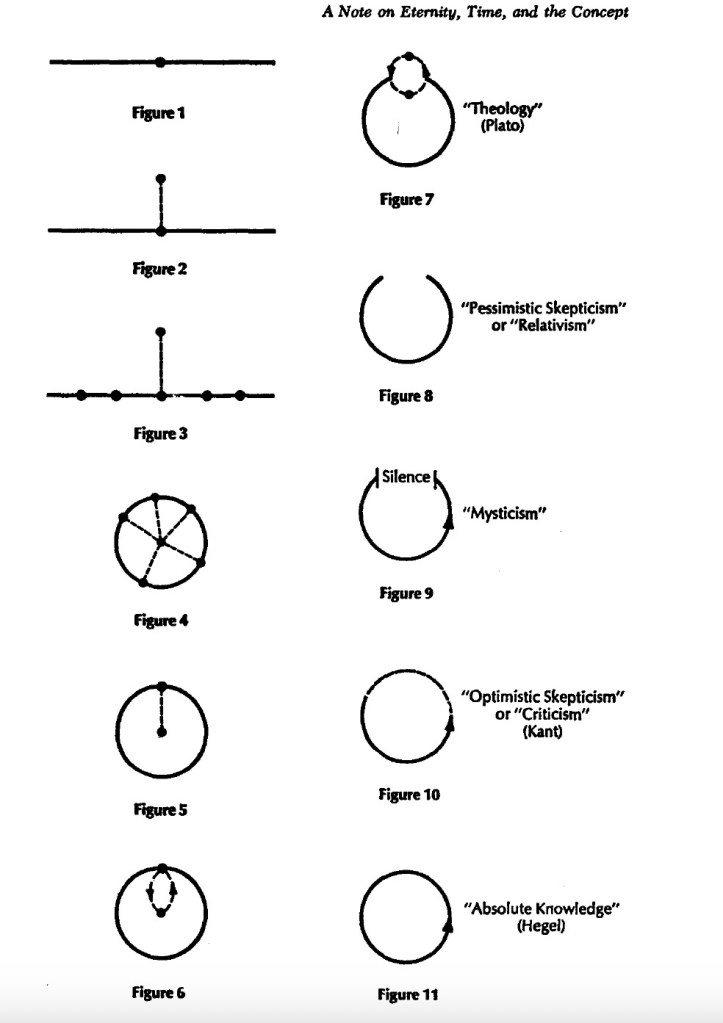
This identification of Concept and Time makes the philosophical project of absolute knowledge possible. If the Concept is temporal, it can evolve, realize itself through history, and account for the historical becoming of truth. Kojève symbolizes this using the geometry of circles: the Concept can recur in time without changing, maintaining a constant relation to Eternity while appearing in the empirical world.
Kojève elaborates this double relation through the metaphor of the Word. The eternal Concept, manifested in human discourse, simultaneously rises toward Eternity and allows Eternity to descend into time. This dual movement is what creates truth. Without the Word, Eternity would be inaccessible to man; without Eternity, the Word would be meaningless. Truth, therefore, exists only through this dynamic relation. And although this relation happens in time, it is not of time—truth is eternal in its structure, yet expressed temporally.
Kojève further distinguishes Hegel’s position from mystical or skeptical systems. In mystical thought, the ineffable lies beyond language and discourse, implying a limit to what can be known or said. Skeptical systems, by contrast, reject the idea of stable truth, as they regard knowledge as endlessly open-ended and evolving. But Hegel’s system, Kojève insists, offers a dialectical path between these extremes. While human knowledge evolves through history and appears temporally, it can ultimately achieve an “absolute” form—a closure of the historical circle. Yet this closure does not eliminate temporality; it presupposes it.
Kojève arrives at one of his central claims: that truth exists only in relation to human time. And human time, he argues, is structured by desire. Desire, especially the desire for recognition, creates a temporal structure in which the future takes precedence over the present. This is the basis of historical movement. Desire negates the present in view of a projected future and transforms the world through labor. Labor (mainly as conceptualized in the Master-Slave dialectic) is thus central to the emergence of the Concept in history.
Kojève explains that conceptual understanding is possible only through human action in time. The detachment of meaning from the empirical reality it signifies is made possible by the temporal nature of being. Mortality allows the separation of word and thing; it is because the real perishes into the past that its meaning can survive as Concept. The word “dog,” for instance, exists only because the living dog is mortal and perishes, leaving behind a meaning.
This analysis culminates in Kojève’s famous formula: Man is Time. Time is not a background container in which events unfold, but the very structure of human existence. Time is the empirically existing Concept, because only through the temporal unfolding of desire, action, and speech does the Concept come into being. When Hegel says, “Spirit is Time,” Kojève interprets this to mean that the human spirit—humanity as a whole in its historical existence—is Time itself. Without man, Nature would be mere Space.
For Hegel (and Kojève), Time is historical time: the time of action, change, and becoming. It is the time shaped by desire and work. Work, born from the Slave’s response to the Master’s domination, mediates between desire and reality. Through work, man transforms the world and gives rise to knowledge. Without work, there is no Concept. Therefore, “the Concept is Work, and Work is the Concept.”
Finally, Kojève emphasizes the mortal nature of man. To attain absolute knowledge, man must accept death. Only a being that can die can experience the world temporally and generate conceptual understanding. Time is not just a measure of change; it is the very form of historical and human existence.
In conclusion, Kojève’s interpretation of Hegel centers on the radical idea that the Concept is not outside of time, but is time. Through this identification, he offers a powerful account of how truth, knowledge, and history are possible; not in spite of human temporality, but because of it. In doing so, Kojève affirms that philosophy, far from being a timeless exercise, is a deeply historical endeavor rooted in the mortal and transformative nature of man.
Notes on Kojève’s Five Possibilities and Their Figures
As stated above, in this chapter, Kojève outlines the metaphysical possibilities for the relationship between the Concept (Begriff), Time, and Eternity –using geometrical diagrams to express these relations, each symbolizing a different metaphysical or epistemological position.
1. The Concept is Eternity, Related to Nothing (Parmenides, Spinoza)
This first position takes the Concept as self-contained Eternity, unrelated to Time or anything external. Kojève aligns this with Parmenides and Spinoza, who assert a closed, unchanging unity (Being or Substance) where conceptual understanding is no longer relational. Here, there is no radius –no movement or relation between the empirical and the eternal –as there is no distinction to bridge.
The Concept is a perfect circle with no points, no entry or exit: no discourse, no temporality.
Since this system does not allow for communication, change, or historical action, Kojève critiques it as inaccessible. It silences the possibility of truth in the world.
2. The Concept is Eternal, and Related to Something Else
This second possibility is divided into two historical variations:
A. Ancient Variant: The Eternal Concept Related to Eternity
a. Plato: Theology (Figure 7)
Plato’s metaphysics posits that the Concept is eternal and refers to an Eternity beyond time. This is represented by a circle with a central point and a radius reaching outward, symbolizing the relation of the temporal word (the point) to an eternal Form.
- The radius: the relation between Concept (within Time) and the Eternal (outside Time).
- The circle: circular Time (the World), in which the Concept can appear repeatedly.
But, since Eternity lies outside of Time, this system is transcendental and theological –marked by a separation between man and God, between finite existence and infinite truth.
Figure 7 – “Theology” (Plato): The small circle (Concept) relates via a radius to the large enclosing circle (Eternity), but Eternity lies beyond the temporal sphere.
b. Aristotle: Eternity Situated Within Time
In Aristotle’s system, the eternal Forms or concepts are immanent in Time, particularly in the cyclic eternity of Nature. Eternity is present in the cosmos. This is shown in Figure 4, where the radius touches multiple equidistant points on the circle’s edge, suggesting eternal recurrence. The circle of Time turns, and at each point, the Concept appears again in the same relation to a stable eternity within Time.
This biological/cosmological vision explains animals and stars, but not historical, free, mortal man. It collapses the freedom of the Concept into a closed, repetitive nature.
B. Modern Variant: The Eternal Concept Related to Time (Kant)
Figure 10 – “Optimistic Skepticism” or “Criticism” (Kant)
In Kant’s system, the eternal categories (Concepts) structure temporal experience, but never entirely grasp reality. There is a partial, directional relation (arrow), symbolizing that knowledge is always reaching toward completion but never arriving. Time is necessary for the application of concepts but their relation remains open-ended.
- The arrow on the circle (Figure 10) shows continuous movement, but the circle is not fully closed: knowledge is an infinite task, not a completed truth.
- The skeptical optimism of Kant is that while we cannot know things-in-themselves, we can structure experience intelligibly.
The circle never closes. The Concept relates to Time but never fully overcomes it.
3. The Concept is Time (Hegel)
Figure 11 – “Absolute Knowledge” (Hegel)
This is Kojève’s preferred and most radical option. Here, the Concept is no longer external to Time. It is Time itself. This means that truth is historical and emerges only through temporality, action, and negation.
- The closed circle (Figure 11) now represents historical Time that has achieved closure through self-reflective Conceptuality.
- The Concept exists empirically, as speech, work, and desire (Dasein), and through this existence, becomes absolute knowledge.
Figure 11 represents the full unity of Time and Concept: Time is no longer an obstacle to truth but its medium.
Kojève writes that this system can explain human freedom, mortality, and history. It is neither silent like mysticism nor endlessly open like Kantian skepticism –it is self-grounding and complete because the Concept has passed through Time and returned to itself.
4. The Concept is Temporal and Relative Only
Figure 8 – “Pessimistic Skepticism” or “Relativism”
This figure shows a broken or incomplete circle, illustrating a worldview in which truth is always deferred and never attained. Kojève links this to historicism or radical relativism.
- There is no fixed point or radius, no Concept that can transcend change.
- Knowledge becomes an endless flux: learning without knowing.
Kojève sees this as philosophy’s failure: an eternal “why” without ever reaching wisdom.
5. The Concept is Eternal, But the Eternal is Ineffable
Figure 9 – “Mysticism”
In mystical systems, Eternity exists, but cannot be represented or articulated. Truth is accessible only through silence. The Concept, in its attempt to speak of the ineffable, falls short.
- The circle is intact, but marked by a silence—a gap in discourse.
- There is a radius, but it does not reach the center.
This system postulates something beyond speech: truth exists, but not in language.
Additional Figures
- Figure 6 represents the double movement of the Concept: from Word (discourse) to eternal meaning, and from meaning back into speech. This double arrow or radius crossing both ways symbolizes the relation that “cuts through the circle” of Time and allows the Concept to transcend temporality without leaving it.
- Figure 5 shows the upward movement from the Word to Eternity: a unidirectional ascent toward truth. But Kojève critiques this as half of the process –without the return, Eternity remains unrepresented in Time.
- Figures 1-3 may represent linear temporalities, divided points of access to discourse, or symbolic preliminaries to the circular representations of higher knowledge systems. For instance, Figure 3 might symbolize a fragmented or pluralistic access to the eternal (multiple points, no circle), unlike the holistic systems Kojève favors.
Conclusion: The Circle as Metaphysical Symbol
For Kojève, the circle becomes the central metaphor of philosophical systems:
- A closed circle (Hegel) represents a self-reflexive Concept that encompasses Time and attains absolute knowledge.
- A broken or silent circle represents skepticism or mysticism.
- A radius marks the possibility of relation: either between Time and Eternity, or between the Word and Meaning.
Ultimately, Kojève’s Hegelian circle (Figure 11) achieves what all others attempt but fail to do: it unifies temporality and truth, discourse and being, man and Concept.
This is not a static truth outside of Time, but Eternity engendered by Time, revealed through the labor, desire, and mortality of man.
Bibliography
Alexandre Kojève, “A Note on Eternity, Time, and the Concept,” Introduction to the Reading of Hegel, Lectures on the Pbenomenology of Spirit, assembled by Raymond Queneau, edited by Allan Bloom, trans. James H . Nichols, Jr., Cornell University Press, 1980.

 liquid ground